

For something a little different today I thought I would broach a bit of a controversial topic, not only to give my perspective, but also to show how culture interacts with economics and politics. All of these systems are interconnected, and changes in the economic landscape can impact culture, which impacts politics, which impacts economics again and the cycle continues.
With that in mind, I wanted to talk today about the Crisis of young men and masculinity in the United States. I’m primarily interested in the situations of men between the ages of 18 and 34. I think women are experiencing a unique set of problems as well, but I only have first-hand experience being a man, so that’s what I’m going to talk about.
Defining Masculinity
So first, what do I mean when I say masculinity? We could really go down a rabbit hole here, and the concept of cultural masculinity is socially constructed anyway, but for our purposes, I want to talk about the lessons I absorbed from the adults in my life and the culture around me about masculinity when I was young. When I was growing up, I learned that being a man was defined by the following:
1. Protector – Your main job is to protect the people around you. This includes your family, friends, and community. But crucially, also strangers. And especially women, children, and people who may not be as well-equipped to defend themselves as you are.
2. Provider – Your other primary job is to provide food, clothing, and shelter for your family, and if you have extra to spare, to extend that provision to your friends and neighbors. Being a provider is kind of like being a protector. It does no good for you to be able to fight off predators or bad actors if your family is going to die from starvation or exposure to the elements. So, think of being a provider as an extension of being a protector. Everything else on this list is important and serves to support your role as protector and provider, but these first two – protector and provider, are primal and essential for men.
3. Be Responsible – Take personal responsibility for your actions. If you make a mistake, own up to it. If you hurt someone, apologize. Then try to make it right. Blaming your problems on someone else is the opposite of masculine.
4. Be Courageous – The idea here is if something dangerous has to be done, you, as a man, volunteer to put yourself in danger before anyone else. In the United States Military, the highest commendation a soldier can receive is the congressional medal of honor, which is awarded very rarely, and only for soldiers who demonstrate extreme bravery and put themselves in danger to protect other people.
5. Be Respectful – Say please and thank you. Sir and Ma’am. Chew with your mouth closed. If you’re seated and there’s a women standing, you get up and offer her your chair. In general, try to anticipate the needs of the people around you, and don’t put your needs above theirs. That doesn’t mean you let people walk all over you, but you certainly don’t walk over other people.
6. Be Honest – You don’t have to answer every question people ask you, but if you are going to answer, tell the truth. Don’t be shady either personally or at work. If you say you’re going to do something, you do it. Don’t make promises you don’t intend to keep.
7. Be Honorable – Have a sense of fair play. Be ethical. Stand up for these principals even when no one else around you will.
8. Be Disciplined – Understand that some of the most important things in life cannot be earned by making an effort once. You have to make an effort consistently over a long period of time to earn them.
9. Be Self-Reliant – Don’t ask someone else to do something for you if you know you can do it yourself. This doesn’t mean you never ask for help. Don’t embarrass yourself by trying to re-tile your own roof if you don’t know what you’re doing.
10. Maintain Your Composure – Keep a level head in times of crisis or when other people are trying to antagonize you. If you let your brain go into fight-or-flight mode every time something bad happens, then you lose access to your frontal cortex and your ability to think critically. This doesn’t mean you can never be upset or never cry. It just means that even when you’re getting emotional, you never completely lose control of yourself. A man who punches the TV or throws things when he’s upset is not in control of himself.
11. Work Hard – Whatever you do for work, take it seriously and be productive when you’re on work time. There are some jobs where people can get away with putting in the minimum effort. But people notice this, and they will weigh your character by how you act when you think no one is looking.
12. Master Your Craft – Develop a skill or trade, and then become so good at it that you’re regarded as an expert. As you get older, your job then becomes to teach the next generation how to do it.
13. Maintain Physical Fitness – Maintain a physical exercise routine and healthy nutrition habits so that your body can serve you in the other goals mentioned above.
14. Be Resilient – Don’t be a person who gives up because you failed once or twice. Failure it a part of life, and necessary for growth. Don’t avoid tasks merely because you think they will be difficult.
15. Be Humble – Don’t flaunt wealth, status, or accomplishments.
16. Set the Example – Remember that younger men and boys are looking at your behavior to determine what is acceptable and what they should be doing.
These are the qualities that defined masculinity as I learned them growing up. Like I said, masculinity is largely a social construct, so there it has no single definition. Note that all of these qualities are things a man can do or be for free, regardless of his job or how much money he makes. However, protecting and providing, which I would consider essential for a man’s sense of self-worth, are gated behind what you do for a living and how much money you make. You can’t very well protect anyone or provide for anyone if you’re working for minimum wage. And honestly, if you can’t protect or provide, then it makes the rest of the virtues I mentioned seem a bit trite. It’s kind of like Maslow’s Hierarchy of needs. Being a protector and provider are like the base of the pyramid, akin to something like food and shelter. Without a good base, you can’t really build anything or grow as a person.
Young Men in Crisis
So what do I mean when I say masculinity is in crisis? How am I measuring that? I want to start by talking about the situation that young men are in today, and then we will relate that to the masculine values we discussed as well as talk about how this relates to culture and politics.
So, here are some statistics for young men and some for young people in general. One in five men between 25-34 live with their parents. This is up from 12% in 2000 and 10% in 1970. So, in 55 years, the percentage of young adult men living with their parents has doubled. The median first-time home buyer is now 40-years-old, which is up from 29-years-old in 1981 and 32-years-old in 2000. In 1980, 71% of men aged 25-34 were married. In 2025, only 35% of men aged 25-34 are married, indicating a 50% relative drop in the marriage rate. According to a 2021 study, 15% of men have no close friends, which is a dramatic increase from 1990, when only 3% of men reported having no close friends. But even more disturbing is if you look at the stats for young adult men aged 18-29, a whopping 28% of them report having no close friends.
The per capita suicide rate for men aged 25-34 increased by 30% between 1999 and 2023. The suicide rate for men overall is at it’s highest level in 50 years. And men commit suicide at 4 times the rate women do. As we know, most suicides are the result of feeling like one’s life is painful, meaningless, or hopeless.
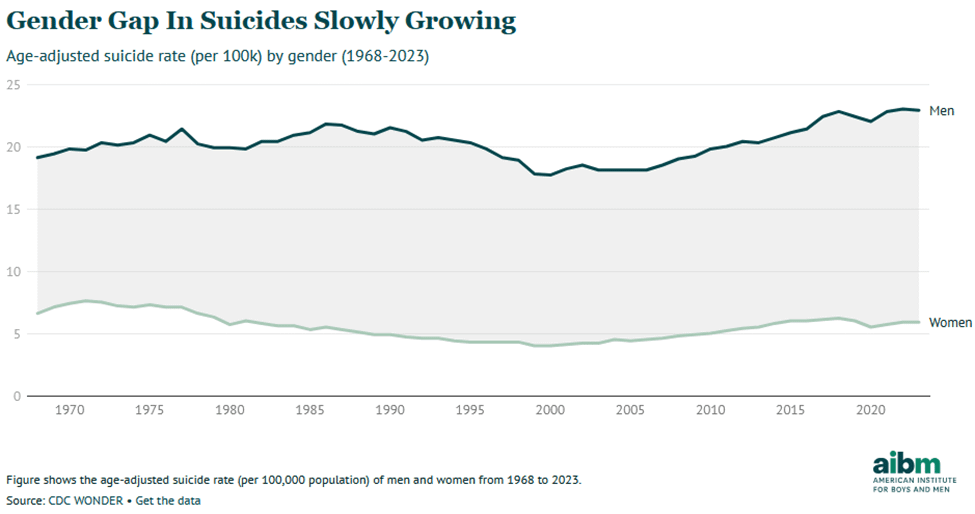
On top of all this, young men’s financial situations have been worsening. And remember that men’s most elemental need is to be a protector and provider. We talked in episode 1 of this channel about how the median income for a young adult man without a college degree is $38,000/year. And you basically can’t do anything with that. Rent alone is at least $1,500/month so after paying rent you’re left with $20,000 a year to pay for your car (which is basically mandatory in most places), your insurance, gas, clothing, utilities, healthcare, and anything else that comes up. I hope you’re not trying to eat too because you won’t have enough money for that. And guess what? This income figure is for men without a college degree, and almost two thirds of young men aged 25-34 do not have a college degree. So this isn’t some hypothetical situation. This is the exact situation that the majority of young adult men in the United States are in today.
What Women Want
Now, before you, as a man, can protect or provide, you need to have someone to protect and provide for. This means you need to meet women, and in order to do that, you need to make yourself attractive to women. How do you do that? Well, a 2019 study surveyed 64,000 women to ask them what they found most important in a potential partner.
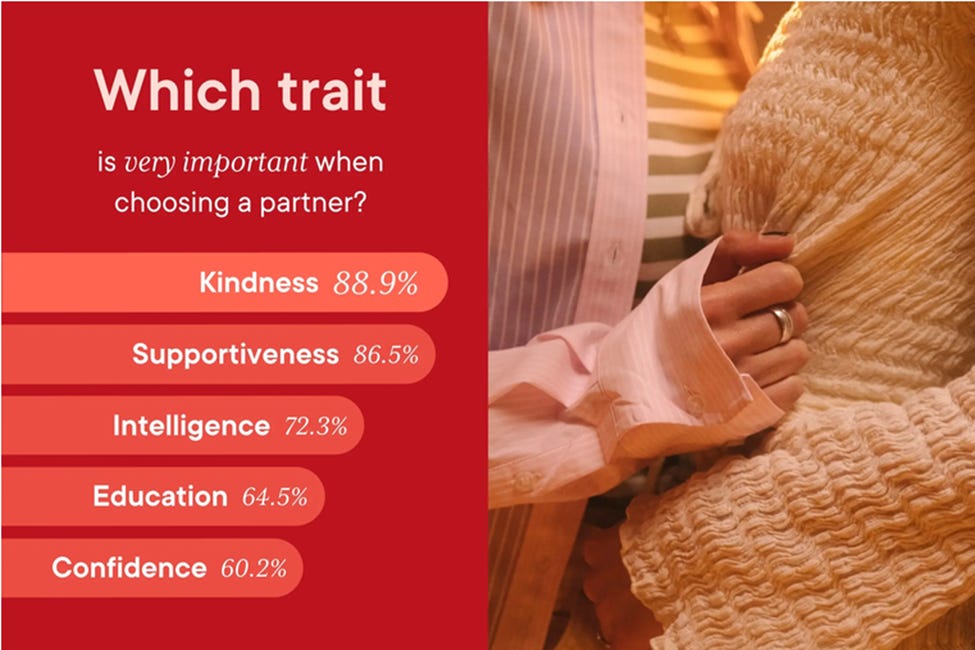
The women surveyed said that Kindness, Supportiveness, and Intelligence were their most valued traits in a partner. However, it’s worth noting that 65% of women said that education was very important, and 60% said financial security was very important. So if we compare what these women want to what young adult men have, we find a mismatch here. Two thirds of young adult men do not have a college degree, which suggests that they are unattractive to 65% of women. And, considering that young men without a college degree have a median income of $38,000/year, which is not a living wage, this makes them doubly unattractive to women.
Now, some of you may be thinking, “but you just said that kindness was the most valued trait. Isn’t kindness enough?” Here’s the thing about this data. It’s survey data, right? So the researchers asked women to say what they value, not to actually commit to anything. When you look at the decisions women actually make for marital partners, the data tell a different story.
A study from the Journal of Marriage and Family found that unmarried men, on average, make about 58% less money than what women their age are looking for in a spouse. Here’s a chart from the Institute of Family Studies which shows the relationship between income and marriage for both men and women. What you find is that there a very strong relationship between how much money a man makes and whether a woman is willing to marry him.
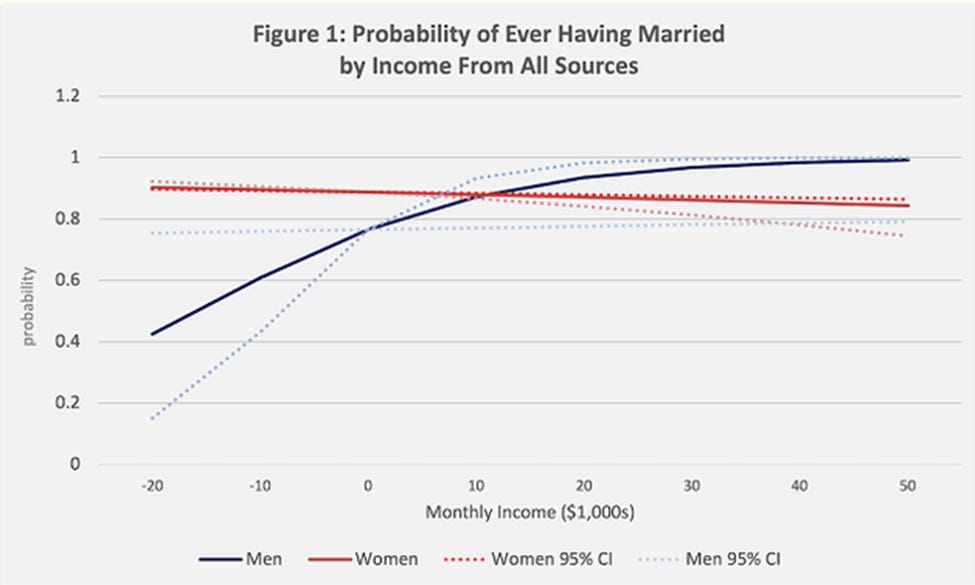
So, I think what you’re seeing in the survey data is a difference in what researchers call stated preferences and revealed preferences. Women say out loud that they want a man who is kind, supportive, and intelligent, which may be true, but the research indicates that the most important things they’re looking for in a potential partner are money and income.
Now, I don’t say this to stir controversy, and I don’t think this means that women are shallow or materialistic. Rather, I think this is an evolutionary adaptation. Women evolved to prefer partners who looked like they could provide for them and for potential children. This is why signaling wealth or earning potential is very attractive for women. Secondary traits like height, which is a proxy for protective ability, intelligence, which is a proxy for earning potential, and humor, which is a proxy for intelligence, are all also valued by women, but less so than money and earning potential, which are the most important variables.
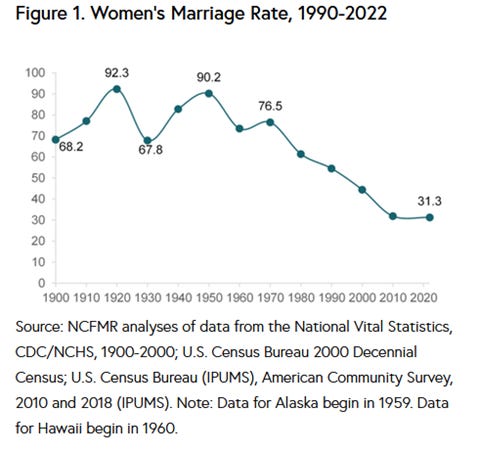
So anyway, as a result of this mismatch between what women are looking for and what young men today can offer, we’re seeing fewer men, and by extension, fewer women, getting married these days. In fact, the marriage rate for women in the US has fallen from around 76% in 1970 to around 31% in 2020.
Looking for Someone to Blame
These statistics paint a pretty bleak picture of young men today. They suggest that many young men are hopeless, rudderless, and lonely. Faced with only losing prospects, we shouldn’t be surprised that many of them are giving up, or trying to get their needs met elsewhere. The Bureau of Labor statistics found that the time that men aged 25-34 spent playing video games and watching TV increased by 48% between 2015 and 2025. I’m not knocking TV and video games, but this is a form of escapism.
So now we can circle back to the concepts of masculinity and culture. While men are escaping more and more into video games and YouTube, they are increasingly finding themselves in these echo chambers of other men who are angry, sad, lonely, and looking for someone to blame for their situation. The men who have been successful at protecting and providing, and may exhibit some of the other masculine values on our list from earlier, are not in the discord chats or in the comments section of YouTube videos, because they are too busy with their wives, kids, houses, and jobs.
One of the most common things we see in the world of clinical psychology and therapy, is what we call motivated reasoning. We’ve discussed this phenomenon before in episode 2. As a reminder, motivated reasoning happens when someone accepts an argument as true, not because it fits the fact pattern, but because it flatters them or justifies their behavior. These echo chambers of male frustration that you find on Discord, YouTube, and various other social media are fertile ground for motivated reasoning. On top of this, it’s worth mentioning that from a psychological perspective, feeling angry is unpleasant, but it feels a lot better to be angry than it does to feel helpless.
The Birth of the “Manosphere”
And hence, the “manosphere” was born. The manosphere is basically a nebulous collection of influencers, podcasters, pickup artists, and grifters, who all share this central theme of “the red pill.” This is a reference to the Matrix which I won’t explain because of course, no one can be told what the matrix is. The red pill philosophy is basically that men need to wake up to the fact that some members of society are intentionally stacking the deck against them. In response to this perceived oppression, they advocate for all sorts of things that are the opposite of the masculine virtues I outlined earlier.
Instead of seeking to protect and provide, they teach that women are objects, that it’s okay to lie to them and manipulate them, and turn men into predators. There are no calls for men to be responsible, courageous, or honorable. Instead of hard work, they look for shortcuts. Instead of telling men to be independent, they tell you that you have to buy their personal development course. Instead of telling men to maintain their composure, they celebrate violence. Don’t learn a trade or a skill, that’s you working for the matrix. Just put all your money into crypto instead. Don’t be humble. Post pictures of yourself with fancy cars and houses, because status is everything. The one masculine virtue they sort of endorse is physical fitness. But they even manage to screw this one up, because they don’t advocate for being strong in order to help other people, but for aesthetics in the service of appearing more “alpha” than other men, leading one author to argue that the manosphere is the gayest thing on the internet.
In short, the manosphere is a collection of people who claim that men are victims of a society that is biased against them. And who do they blame for this situation? Well, basically anyone who isn’t like them. They primarily blame women, minorities, immigrants, and academic elites.
Men’s Struggles Weaponized by the People Who Caused Them
And here is where we tie politics into this whole situation. What is the predominant political affiliation of women, minorities, immigrants, and academic elites? They’re progressives. They’re liberals. They’re leftists. They’re Democrats.
I once heard an economist talking about how the political right have done a much better job using social media to spread its message than the political left. I don’t think this is correct, because I don’t think that this started out as a coordinated political effort. It started out as young men feeling anger and shame at not being able to earn a living wage, which resulted in more men being single and unmarried, which led to them feeling depressed, which led to escapism and increased use of social media, which was filled with other frustrated young men. Throw in some motivated reasoning and self-serving bias and before you know it, you have an absolutely enormous group of young men who are already blaming progressives for their problems without any evidence and without any monetization from the political right.
Of course, once this ball got rolling the whole manosphere turned into a feeding ground for extremist right wing political thought and scam artists who were looking to capitalize on the rage and vulnerability of these young men by selling them peptides, erection pills, crypto currencies, and get-rich-quick seminars.
And the ironies of all of this are so thick that they’re almost poetic.
I explained in the first five episodes of this channel how the downfall of the working class in the US started with the election of Ronald Regan in 1980.
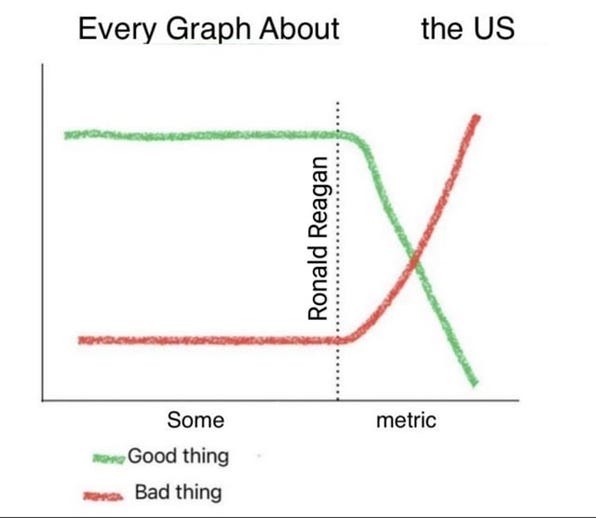
The US government has moved farther and father to the right for the past 46 years. It has cut taxes on the wealthy, cut social programs for the poor, stopped serving ordinary people, and started only working for the interests of wealthy corporations. So, the political slide to the right, and the election of right-wing politicians, is the primary reason that young adult men without a college degree are financially struggling so much right now. And…these same people keep voting for politicians on the right. Do you see how circular this is? They vote themselves into poverty, and then they’re upset that that their lives are hard, so they go out and elect right-wing politicians who keep selling them the idea that women and minorities and academics are the problem, while invariably making their lives even harder.

The Manosphere Is Sabotaging Relationships
On another ironic note, the manosphere itself has radicalized so many young men into believing that women are the problem and that policies like allowing women to vote and allowing them to make choices about their own bodies are somehow holding men back. And they wonder why women don’t want to date them. If your starting position is that women are less than men, then most women aren’t going to want to date you even if you’re tall, and rich, and have a perfect jawline because you smashed your face with a hammer.

Pop culture masculinity is basically an autoimmune disease. Men’s egos are threatened, and in response they’re rejecting the virtues that made them so powerful and attractive in the first place.
As I have said before, I am not a democrat. I’m just a guy watching all these cogs move, as the American political machine drives us off a cliff.
An Economic Solution is Mandatory
So, what do we do about this? How do we reverse the trends in male suicide and loneliness? Well, I don’t know all the necessary conditions to fix this. But I can guarantee that you won’t fix it without restoring men’s ability to function as protectors and providers. Take a look at this graph from the National Institute of Health.
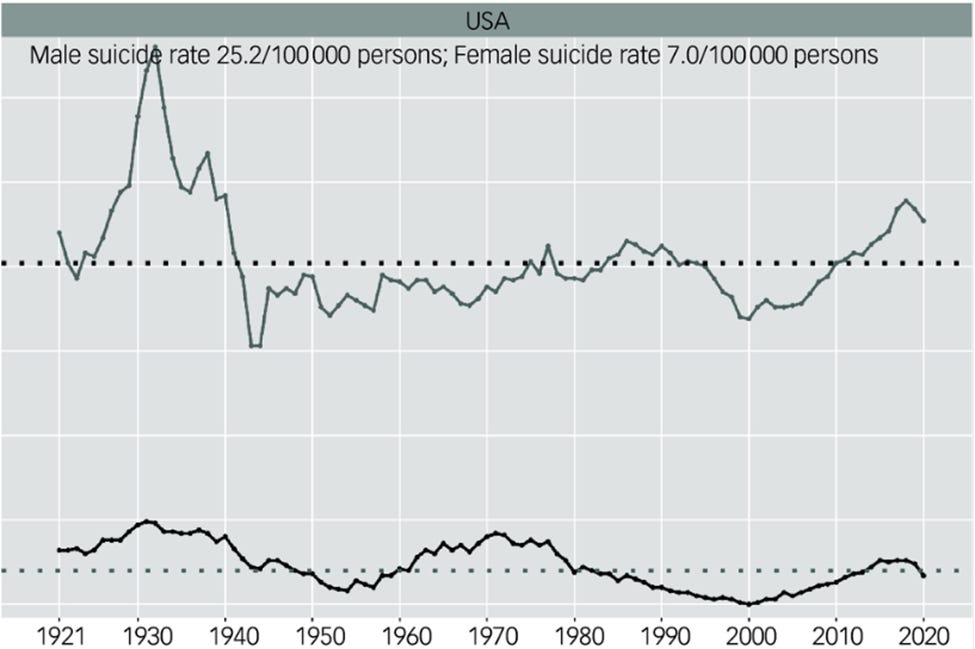
The top line is the suicide rate for men in the United States. Look at 1929. This was the start of the great depression. Male suicide rates went through the roof. The female suicide rate was more or less unchanged. The male suicide rate peaks at an all-time high of around 30 per 100,000 in 1932. Now, the story we’re often told is that that the rise of US manufacturing spurred by World War II is what increased wages and living standards among working people. And there’s some truth to this. But the US didn’t enter World War II until 1941. And if you look at our graph, you can see that male suicides started falling significantly around 1934.
Well, guess what happened in 1933? FDR took over as president, and introduced “The New Deal.” This was a policy that dramatically improved the lives of ordinary people by increasing taxes on the wealthy and reinvesting this money in infrastructure and public works programs, all of which paid ordinary men without college degrees living wages. Economic conditions for men improved, their role as providers and protectors was restored, and they stopped killing themselves in record numbers.
So, the answer, in my view, to the masculinity crisis, or at least one of the answers, is already known to us. We just do what we did before in the 1930’s. We tax the extremely wealthy, we invest this money in infrastructure and good jobs, and we restore men’s dignity and sense of purpose. Once you do that, the manosphere will collapse in on itself like a dying star. But until you do it, the manosphere will continue to demonize the people and policies that would make it possible for men to thrive again.