

Today we’re focusing on Indiana, and the ways in which the state seems to be trying to create the least efficient criminal justice system in the country.
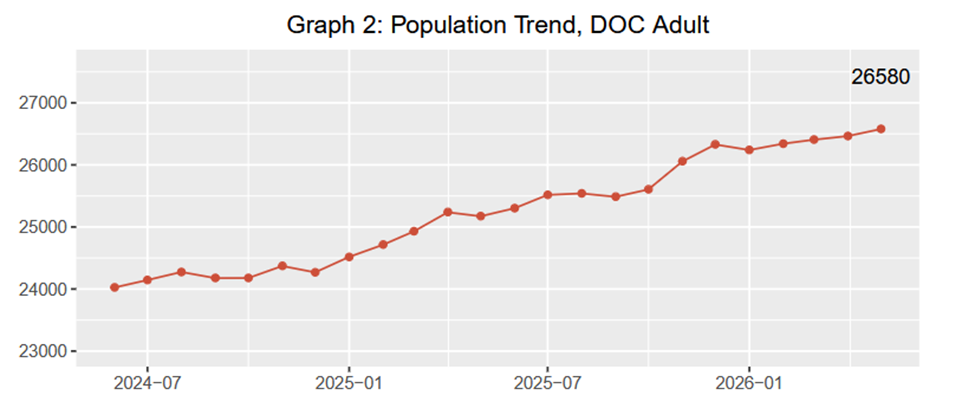
So what are we talking about here? As of May 2026, the Indiana Department of Corrections (IDOC) held about 26,600 people in state prisons. IDOC, across all state prisons, has a capacity of 26,812. This means that the Indiana State Prison system is currently operating at over 99% capacity. This figure is up from around 24,500 in 2024. I have included a graph published by IDOC which charts this increase.
Strange as it may seem, the capacity problems in the state prison system actually impact county jails on a day-to-day basis. Remember that jails house people temporarily before they’re either released back to the community or, if they’re convicted of a crime, are moved to the state prison system. What do you think happens when the prisons are full? The inmates convicted of crimes have to sit and wait in the county jails until a prison bed is available. This drives the jail ADP up. According to the most recent estimates, there are about 1,124 inmates in county jails across the state who are waiting on transport to the state prison system.
The reason I mention this is that local jails across the state are also operating at or near capacity. The most recent data comes from the Indiana Criminal Justice Institute. According to their December 2025 report, 34 (or one out of every three) jails in Indiana are operating over their recommended capacity. What you’re seeing is that because the prison system is so full, you’re getting a backlog at the county level, which is contributing to county jail overcrowding as well.
Here is how I want to structure this discussion: First we’ll first talk about why the prison population is increasing. Then we’ll talk about why this is problematic. And we’ll end by talking about what the state would need to do to resolve this issue. And, stay with me here because this story involves a bit of legislative tomfoolery.
Why the Prisons are so Full
The first thing to note is that the number of prisoners in the state system now, despite being at the highest level in recent years, was actually even higher back in 2013. In 2013, the state had 30,000 inmates, but only about 26,000 beds. This meant that IDOC was operating at 115% of their absolute maximum capacity. As a result, you had prisoners sleeping on gym floors, three men in cells built for two, and all sorts of other jerry-rigged housing setups.
As you can imagine, this didn’t go well. The prison classification department was basically frozen and forced to mix dangerous felons with non-violent offenders, as well as mixing rival gang members, which of course results in significant increases in fighting, stabbings, etc.
HEA 1006
So, Indiana passed House Enrolled Act 1006 in 2014. If you’re a nerd you’re welcome to go read the whole thing, but for our purposes it did two important things. First, it banned counties from sending low-level felons (also known as level 6 felons) to state prisons. Since level 6 felonies account for 70% of all state felony filings, this dramatically shifted the burden of housing low level felons. The county jails would now have to hold a whole bunch of additional inmates in their custody while they served their sentences for level 6 felonies, which range from 1 year to 2.5 years in-custody. This had the impact of significantly increasing costs for county governments who historically were not responsible for housing these inmates.
The other thing that HEA 1006 did was increased sentences for serious offenses and mandated that convicts serve at least 75% of these sentences before they would be eligible for parole. This is an increase from 50% in the past. Setting aside the ethics and evidence (or lack thereof) for this policy, the practical implication is that it will take longer for inmates to work their way out of the prison system, thereby putting upward pressure on the prison ADP.
The overall impact of this legislation, rather than addressing the cause of the overpopulation problem, was to move this burden onto county governments, while simultaneously creating conditions for the prison population to grow.
HEA 1004
Fast forward to 2022. Eight years later, this legislation did exactly what we predicted it would, and caused widespread overcrowding in county jails. So, under pressure from county administrators and sheriffs, the state passed HEA 1004. In an almost complete reversal of the policies of 8 years prior, HEA 1004 said that county courts could send their convicted level 6 felons to state prisons once again.
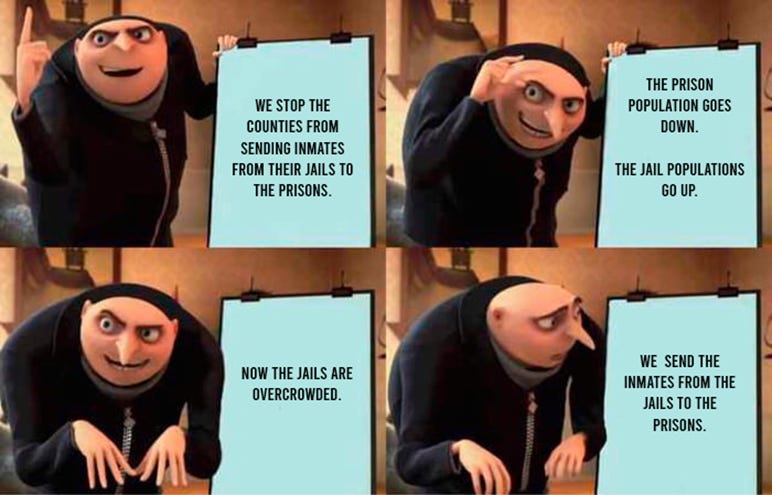
The courts started sending level 6 felons back to the state prisons. Over the course of a couple years, the state prisons filled up again, can no longer accept transfers from jails, and the jails are overcrowded now too.
So now what do you do? The prisons and the jails are overcrowded so you can’t move inmates back and forth between them anymore. We’ll come back to this, but we need to talk about a couple other things first.
Why Not Just Build More Cells?
One of the most obvious solutions to this problem, while certainly not the cheapest, is to build new facilities. And in fact that has been happening. Between 2019 and 2024, Indiana county governments built new jails and expanded old jails in order to add 3,000 more jail beds statewide. So, during that time when the jail populations were bursting at the seams, the counties were actually trying to build their way out of it. And despite all this extra building, we still have a third of county jails over their recommended capacity as of the end of 2025.
SB1
Another complicating factor in all this is that in 2025, Indiana passed SB1. In layman’s terms, this was a bill aimed at cutting property taxes. The problem with that is that property taxes are the main revenue source for county governments, and county governments are the ones responsible for maintaining and staffing the jails. Dr. Larry Deboer, an economist out of Purdue University, did a study last year on the anticipated impact of SB1. He concluded that SB1 will reduce the operational budgets of county governments by 25%. What this means for our purposes is that counties, who were already struggling with jail overcrowding, and cannot send inmates to the prisons because they’re overcrowded, are now being actively defunded, so that they will not be able to afford to build additional jail beds, hire additional correctional officers, or subsidize diversion and rehabilitation efforts. We’ll come back to this in a minute.
Now - the state has been building additional prison space as well. As I mentioned earlier, the Indiana legislature had been aware that they were running out of prison beds for a while, and that the actual prison buildings were getting old. So in 2021 they committed to building a new Westville facility. This project was increased in scope in 2023 to create a larger facility with more beds, at the cost of $1.2 billion. This facility is set to open in 2027 and will hold up to 4,200 prisoners. Now, part of the reason that the state is building this new prison is that they need to shut down the old Westville facility which is like 75 years old and basically not worth the cost of renovating and repairing. This facility had 3,500 beds. So closing the old facility and opening this new facility will add a net 700 beds for the entire state prison system. This will bring the number of IDOC beds up from 26,812 to 27,512.
Assuming nothing else, if you snapped your fingers right now and added these 700 beds, IDOC would still be operating at 97% capacity. But, remember that there are about 1,124 inmates in county jails right now waiting to be moved to the state prisons. If you suddenly moved them into this newly created space, IDOC would be operating at just over 100% physical capacity. On top of this, you can’t assume that the prison population is going to sit still until 2027. The prison population increased by 7.4% between 2024 and 2025. And based on figures from May of this year, is on track to increase between 2.5% and 3% in 2026. In short, by the time the new Westville facility opens in 2027, every bed will be spoken for, the facility will be overcrowded, and there will still be a wait list.
The Correctional Officer Shortage
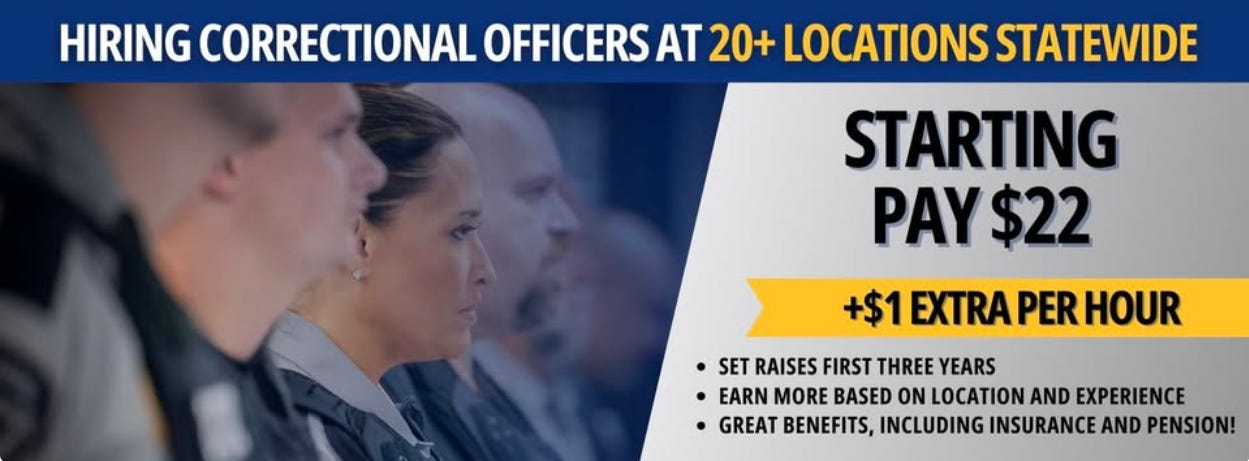
But that’s not even the end of the bad news here. IDOC is running about 1,000 corrections officers short, which means that they may not even be able to properly staff all of the beds they have. And it’s not like this situation is improving either. They are actively bleeding staff. According to the Bureau of Labor Statistics, Indiana is projected to lose about 8% of it’s corrections workforce by 2032. The reasons for this are fairly obvious. The job is hard, dangerous, you’re often forced into working overtime, forced to work short-staffed, and working in poorly maintained buildings with few windows. And on top of all of this, IDOC starts you at $23/hour, which, as we established in episode 1 of this channel, is not enough money to cover even basic expenses.
Also episode 9 of this channel explains why jails, rather than prisons, are short-staffed. The dynamics are slightly different so check that out if you want to learn more.
The problem is basically the same in both cases. It’s that compensation rates are way too low. They’re hiring police officers in my county at almost double what IDOC is paying. Additionally, since 2025, state prison recruiters now have to compete with ICE. Their recruiting standards are basically identical, but the hourly pay is about 50% higher, they’re giving out $50,000 signing bonuses, tuition reimbursement, and you don’t have to spend all day inside of a dungeon. Remember, incentives are everything. You need to increase the incentives if you want to recruit and retain more corrections officers.
Cuts to Community Corrections
IDOC doesn’t have enough beds, even with a new facility opening in 2027, and they aren’t going to have enough officers to staff it anyway. So what’s next? Let’s talk about how this situation has been exacerbated by the state’s decision to cut funding for community corrections.
For those of you unfamiliar with community corrections (sometimes referred to as work release), it’s basically a collection of programs designed to help divert people out of the criminal justice system and avoid sending them to prison. It’s sort of an everybody wins type program because it helps offenders by allowing them to keep working, participate in treatment, and give back to their community. And it helps jails and prisons by reducing their populations. On top of all this, it helps county and state governments to save money.
So what happened? In 2025, the Indiana legislature passed House Bill 1001 which was focused on the state budget generally, but one of the things it did was cut the IDOC reinvestment grants, including community corrections, for the next two years by $7 million. Ironically, this seems to have been done in part to help the state pay for their universal school voucher program, which, as I explained in episode 23, is simply a way to steal money from ordinary people and redistribute it to wealthy people.
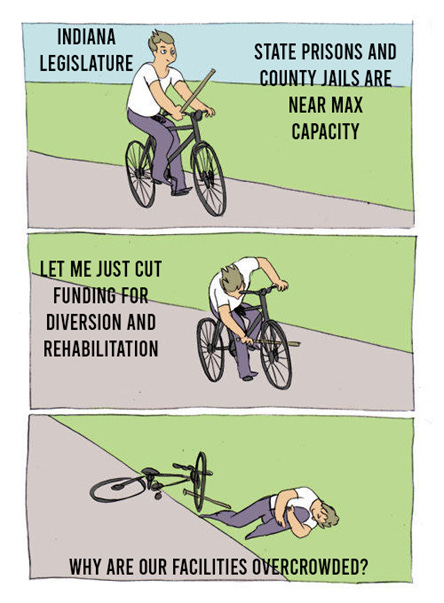
Now, for a lot of community corrections programs, these state grants are their most significant source of funding. So cutting this funding means that the programs will need to eliminate staff, beds, programming, or otherwise scale back their operations. This means fewer people served by community corrections, which means more people getting caught up in probation or technical violations, and more people ultimately getting sent to prison.
The sad thing about all this is that the legislature knows all of this. They know that cutting funding for community corrections is going to drive more people into prison. So why did they do it?
Well, only they could tell you that. But I suspect they won’t, because this seems like it was a political shell game. The state’s elected officials can tell voters they passed a balanced budget and protected the state’s $4 billion surplus, while at the same time giving them universal school vouchers, which, ironically the average voter isn’t educated enough to see is just a reverse Robin Hood scheme.
Why This Strategy is Wasteful
Between HEA 1006, HEA 1004, and the recent cuts to the justice reinvestment grants, the entire criminal justice system has been setup for inefficiency, waste, and failure. According to the US government’s own website, it is 10 times more expensive to detain someone in jail or prison than it is to use community supervision programs like community corrections, probation, and problem-solving courts. Another study found that for every $1 invested in drug diversion programs, the community saves $12. Yet another study found that every $1 invested in community reentry programs saved the community $6. Work release programs also return about $6 dollars to the community for every $1 invested. There’s a great website from the Washington State Institute for Public Policy which details studies on all sorts of diversion and reentry programs and compares costs and savings. I recommend you check it out.
How to Fix It
Looking at this mess that Indiana has created for itself, what should they do now? Well, in short, they should roll back most of the changes they’ve been making for the past 13 years. I’ve kind of already covered all of these things but I’ll review them briefly.
First, the state should immediately reinstate the $7 million that they cut from community corrections programs throughout the state. In fact, they should probably add another $7 million on top of that, because these programs are extremely lucrative investments from a taxpayer perspective, and the better funded they are, the more inmates they can divert out of the jails and prisons.
Second, the state should repeal SB1 from 2025. The bill effectively crippled county governments at a time when a third of them have jails that are overcrowded and need to build additional space. SB1 wouldn’t be the worst thing in the world if local governments were allowed to hold referendums to keep their property taxes the way they were. However, since the legislation bars them from doing this, the bill is unequivocally bad and simply needs to be repealed.
Third, the state should seriously reconsider the criminal statutes related to substance possession. For example, having the tiniest amount of cocaine, heroin, or methamphetamine, even 1 or 2 grams, is enough to get a felony possession charge and get sent to prison. So, someone could have $100 worth of methamphetamine on them, and because of that $100 of narcotics, we’re going to spend more than $30,000 in incarceration costs alone. Wouldn’t it make more sense, and be more just, to simply take the drugs away and put the person in treatment? Or try electronic monitoring? If there were dangerous or aggravating circumstances, then maybe a felony charge is appropriate, but otherwise we’re spending a lot of money to punish people who, in all likelihood are using drugs because they have a physiological addiction and/or a trauma history.
Now, I can already tell some people are going to roll their eyes at me. Will is a hug-a-thug type who thinks that all criminals are just misunderstood and need to be nurtured. And I am not that. All I am saying is look at the economics of the situation. There was a study out of the Pew Research Foundation which compared the criminal justice systems of states like Indiana, Louisiana, and Alabama which have these very punitive felony statutes for simple drug possession, to states like Massachusetts and New York which have less punishing statutes and more support for diversion and drug treatment programs. What they found was that states like Indiana that took the punitive approach did not reduce overdose rates, did not reduce general drug use rates, did not improve public safety, and ended up spending significantly more per capita on their criminal justice systems.
All I am trying to do here, is to help ordinary people. When your state runs it’s criminal justice system in this sort of backward and nonsensical way, it ends up wasting tax dollars. Every tax dollar wasted in this way is a dollar that wasn’t spent on your roads, schools, fire departments, hospitals, and so on.
Indiana is a state that prides itself on being fiscally responsible. I’ve just explained how their criminal justice system is setup for inefficiency and waste. Now, I would be happy to work with any of the state’s legislators to craft some evidence-based policy reforms to stop the jails and prisons from being overcrowded, improve public safety, and save tax dollars. I’ll even do it for free. My email address is on this website.
If you live in Indiana, reach out to your elected officials. Let them know you’re concerned about overcrowding in the jails and prisons and inefficiencies in the criminal justice system. Let them know they can save money with some simple and evidence-based policy changes. Send them this video. If you live in another state, then now you know what not to do.