

If you read the title of this article and still clicked on it, know that I appreciate you, and your trust in me will be rewarded. I know that the national debt is not a sexy topic, but it’s extremely important to understand in the context of our current mental health crisis. Bear with me for a few minutes because I have to talk money for a while, but I will eventually bring it back to mental health and all will become clear.
US Deficits and the US Debt
So, unless you’ve been living under a rock, you’re probably aware that the United States has accumulated an enormous national debt. At the time of writing, it’s at about $39.5 trillion dollars, which is a little disturbing to me because it’s risen by one trillion dollars since I started making these videos in 2025. The reason the debt is so high is that every year since 2001, the US government has spent more money than it made in taxes. When this happens, it’s called running a deficit. If you look at this graph, you can see how much of a deficit the US has run each year since then.
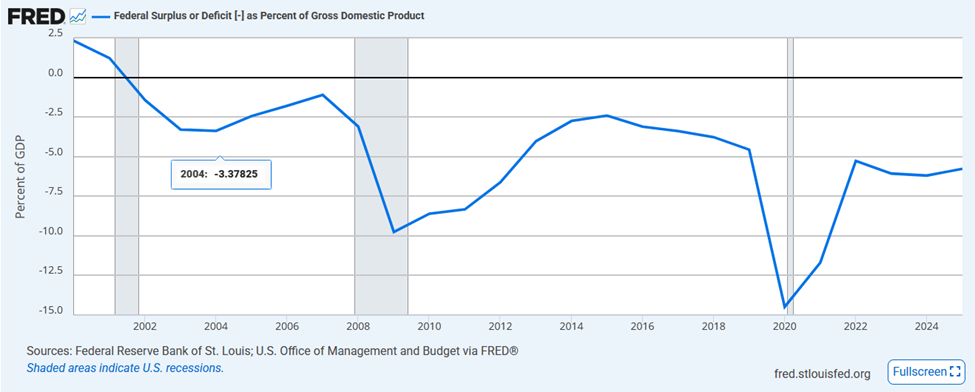
Now, this graph only shows the deficit spending for each budget year. It does not show the total debt. Every year that the US runs a deficit, it has to borrow money to cover its obligations. This would be like if your paycheck didn’t cover all your bills at the end of the month, so you had to put one or two of your bills on a credit card.
As some of you may know, when you don’t pay off your credit card bill, you have to pay interest on the balance. That is, you owe more money than you originally borrowed, which is basically to compensate the people you borrowed it from for the time they have to go without their money. Credit cards often have rates upwards of 20% annually in the form of interest. So, if you borrowed $1,000 and didn’t pay it back, you would owe $1,200 after a year.
What if you not only didn’t pay back what you owe or the interest, but you kept charging the credit card for more purchases every year? You would quickly find yourself in a compounding interest trap. That is, the amount of money you owe back increases exponentially every year. This is why the US deficit graph looks so much different than the US debt graph, which looks like this:
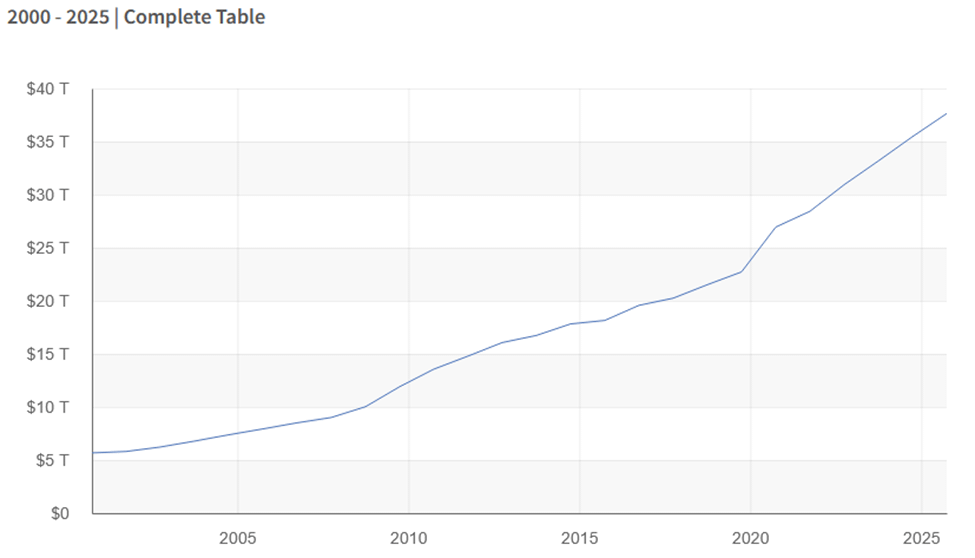
This is basically what it looks like when America doesn’t pay off its credit card bill for 25 years. Not only is there a mountain of debt - $115,000 for every man, woman, and child in the country, but the interest payment on this debt is now at an all-time high of $1 trillion per year. In other words, if every living person in the US paid about $3,000 per year to the federal government, that would just barely cover our annual interest payment, without anything going toward the principal.
Okay, so I’m another person ranting about the national debt. You hear conflicting and confusing stories about this in the news all the time, so I would understand if you don’t know what to think about the national debt and whether we should be worried about it.
Well, I’m going to clear that up for you. It is a big deal, and you should be worried about it, and the worse it gets, the more your living standards are going to fall, and the worse our collective mental health will be. Allow me to explain.
Your Options if You’re in Debt
Let’s go back to using our credit card analogy. Imagine you owe a lot of money on a credit card – let’s say $80,000. However, your budget is maxed out, and you can’t currently afford to pay anything toward that credit card. What would you do to address the problem? Well, short of declaring bankruptcy, which doesn’t work for our analogy because the US can’t do this, you realistically only have 3 options.
First, you can make more money. If you find a job that pays you more, or you take on a second job, you’ll have more money, and you can put this additional income toward your credit card debt.
Second, you can spend less money. If you find a way to scale back your lifestyle somehow, maybe go from two car payments in your household to one, start packing your lunch every day, or cancel some of your subscriptions, then you might have a little extra money each month to put toward repaying your debt.
Your third option is to kick the can down the road by taking out another credit card to pay off the first one. Note that this last option doesn’t actually solve your problem. It postpones it. But it’s actually worse than that, because whenever you take on new debt, like opening a new line of credit, the people you’re borrowing from will look into your background to calculate how risky it is to lend to you. The riskier you are, the more interest they’re going to charge you to take out another loan. So, what happens is the more times you do this, the riskier you become, and the more creditors are going to charge you in interest on a loan.
Now, if you end up in credit card debt in real life, the smartest thing to do is a combination of the first and second strategies. Cut spending on anything that isn’t critical to your survival, and find a way to bring in more money.
Exploring These Options RE: the US Debt
The US government is in a very similar situation. We have been consistently running a budget deficit for 25 years, and we have accumulated a debt that is roughly the equivalent of our gross domestic product or GDP. If you don’t know what GDP is, a shortcut to understanding it is to think of it as all of the money that everyone in the country spent in a year. So, that’s how much money the US owes to it’s creditors. I used the figure of $80,000 for our analogy, because that’s how much money the median household in the US makes in a year. So imagine if your household made $80,000 in a year, but was also $80,000 in debt. That’s kind of the situation the US is in.
What options does the United States have for dealing with our debt? I’m going to take these in reverse order because you have to understand why options two and three won’t work before we get to option one.
Kicking the Can Down the Road Won’t Work
Option three, we can kick the can down the road. This is what the US has already been doing for the past 25 years. Every time our debt comes due, we take on new debt to pay off the old debt. The government prefers to call this refinancing but it’s essentially the same as using a new credit card to pay off the old credit card. Now, you might be wondering, who is it that keeps lending the US all this money so we can keep putting off our debts?
Well, it turns out that a lot of both individuals and foreign governments have been lending money to the US government. The vast majority of this debt is held in the form of bonds, which are held by investors inside the United States. A bond by the way is just a term for a loan that can be traded back and forth with other people. So, 75% of the US debt is owed to investors inside the US, and the remaining 25% is held by foreign investors and foreign governments.
This point is slightly tangential, but it’s important to note that when the US government runs out of money, it deals with this primarily by borrowing money from wealthy citizens inside the country, and paying them interest for the privilege of borrowing their money. This is basically what buying US bonds is. We will come back to this point in a couple minutes.
Now, the problem with all of this kicking the can down the road, or “refinancing” that the US has been doing, is that, like the person who keeps rolling their credit card debt over into other credit cards, the people lending us money are starting to view the US as a potentially risky investment. This means that people who used to lend us money at one or two percent interest are now expecting five percent interest. At the time of writing in July 2026, 30-year US bond yields are at 5.1%.
This is kind of like having an adjustable-rate credit card. It’s basically a nightmare scenario for the United States. Not only are you fighting exponential compound interest on the mountain of debt you’ve accumulated, but you’re facing a higher interest rate every year.
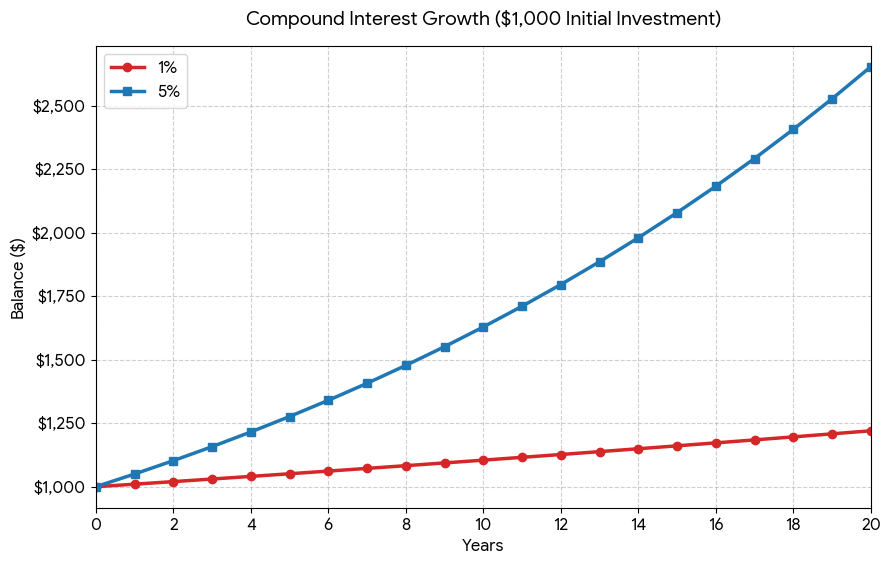
What ends up happening, which is what’s happening in the US right now, is that each year you have to borrow at a higher rate, which makes you take on debt at a faster rate, which means that next year you’re going to have to borrow at an even higher rate, and so on and so on.
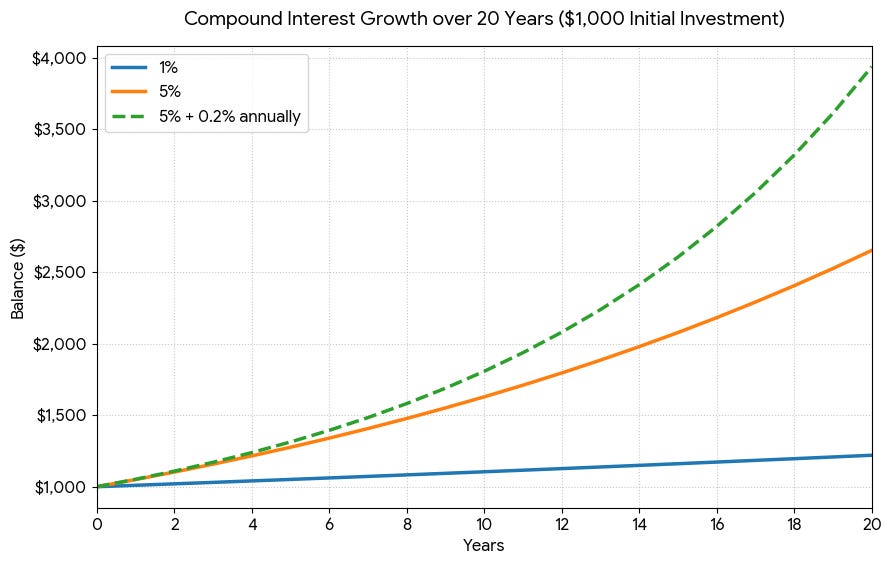
Financial professionals sometimes call this a debt spiral. The longer it goes on, the harder it will be to climb out of the debt, and eventually we will hit a wall where investors believe the US will not be able repay our debts, and people will simply stop loaning us money.
Why We Can’t “Inflate the Debt Away”
Now, some of you may be thinking, “ah, but I know a way out of this.” We can just “inflate our debt away.” What it means when people say this, is that if inflation is high enough, then we can pay back our loans in currency that is less valuable now than it was when we borrowed it. I realize that this concept is confusing so I’ll give you a real-world example.
Let’s say you borrowed $300,000 at 5% interest to buy a house. However, the housing market is booming, and after 10 years, your house is worth $600,000. So, whoever lent you $300,000 at 5% interest would be owed about $490,000…but your house is worth $600,000 now, so you could easily sell your house, pay off your debt, and make a tidy profit. What has effectively happened here is that the value of your house inflated at about 7.2% annually, which was higher than the 5% interest you agreed to pay on the original loan.
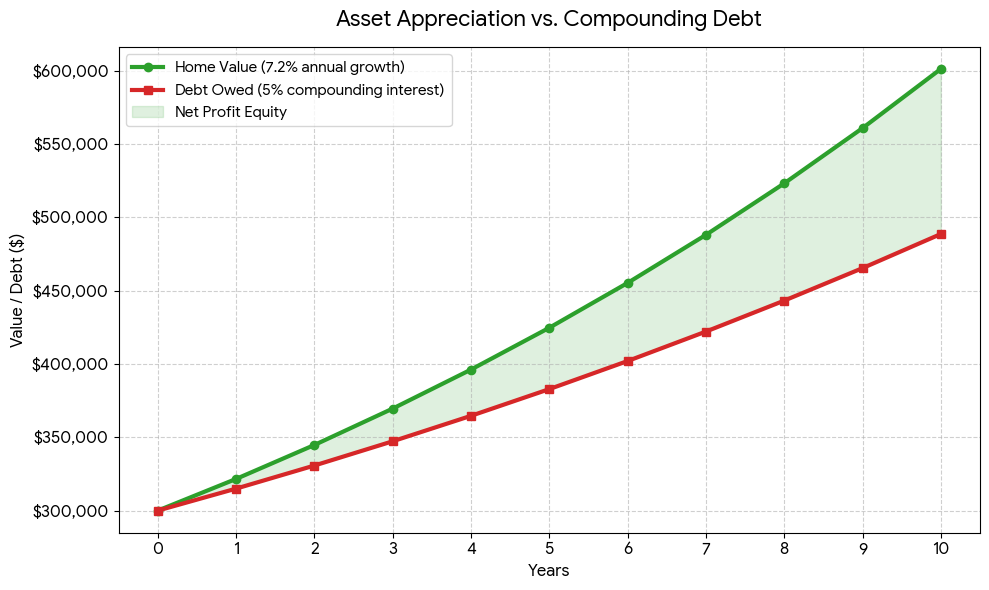
This is essentially the concept of inflating away the US debt. We could pay down our debt easier if we let inflation run high, because it reduces the real value of the debt we have to repay.
So, the first problem with doing this is that inflation tends to hurt poor people the most, because they have nowhere to invest their money to protect it from inflation, and because they spend all their money, they can’t cut back on spending. I am not a fan of solving problems by offloading them onto poor people.
Now, the bigger problem with this strategy, and the reason that it won’t work for the US, is that people who lend money, especially in the amounts that we’re talking about, are not stupid. When they see the US inflation rate starting to rise, or if they even read a news story suggesting that it’s going to rise, they will respond by refusing to lend the US money unless we pay a higher interest rate.
So, to summarize, we cannot choose option 3, to kick the can down the road, because it forces us into a debt spiral which terminates in the US losing the ability to borrow any more money. This leaves us with options one and two.
Cutting Spending Won’t Work
Option two, if you recall, is to cut spending. Unfortunately, the US budget is extremely tight as it is. In 2025, the executive branch created the Department of Government Efficiency, which was tasked with cutting federal spending by any means necessary, rooting out any redundancies, and maintaining only critical spending. Billionaire Elon Musk was up on stage with a chainsaw apparently trying to demonstrate how aggressively he was going to cut wasteful spending. Ironically, the most generous analysis found that this new department only reduced spending by about two billion dollars, which is less than one one-hundredth of a percent of the federal budget, while the most critical analysis concluded that it saved no money, and ended up wasting about 20 billion dollars.
So, I think the reason that the government was unsuccessful here goes back to what we spend our money on. Our government spends about 21% of the budget on social security, 15% on Medicare, 11% on Medicaid, 14% on Defense, and 14% on interest on our enormous debt. This leaves about 25% of the budget remaining to be spent on education, transportation, research, agriculture, law enforcement, national parks, and so on. There’s really not a lot to cut.
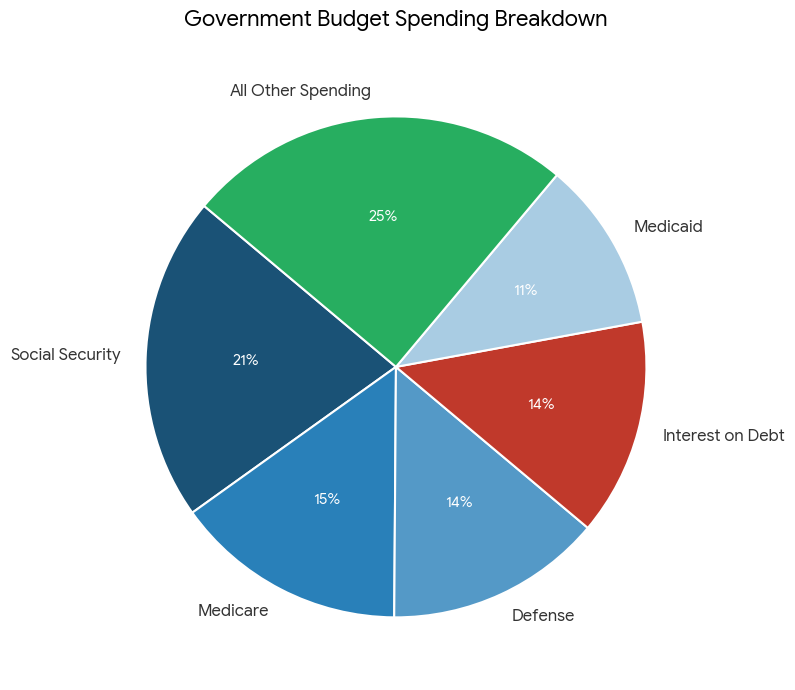
The bulk of the spending is either on things that keep our population alive and healthy, or things that are essentially necessary investments in our future like education and research spending. I’m not the expert in defense spending, but this seems like something that could be trimmed. However, the defense sector is, other than the healthcare or financial sectors, probably the most entrenched lobby in Washington, so I don’t think you’d be able to cut that spending significantly even if you wanted to. And even the most ardent political hawks have been afraid to go after social security or healthcare spending for decades because they know this is a third-rail issue for their voters.
My point here is that option two, cutting spending, is not realistic. We tried it last year, it only ended up costing us more money, while cutting valuable services. This means that the only option remaining is option one: find a way to make more money.
We Need to Make More Money
Remember that governments make money through taxes. Making more money means making more from taxation. There are two ways to do this. First, you can increase overall economic growth in your country (the primary metric for this is GDP which we discussed earlier). If GDP goes up, this implies that on average, people in your country are making more money, which means that you as the government will collect more in taxes.
You Can’t Grow Your Way Out of This
So…I’m just gonna go ahead and rip the band-aid off now and tell you that increasing GDP in order to increase tax receipts isn’t going to work. The US has been growing at a very fast rate (something like 2.5-3% annually) for the past 40 years. The problem with that is that if you’re already growing very quickly, it’s hard to significantly increase your growth rate. It’s basically unheard of outside of a huge national event for a country to have growth rates higher than 3%, and when it does happen, it’s not sustained. On top of this, US GDP for the past several years has actually been falling, and as of the end of 2025 was only at 0.5% year-over-year.
Okay, so you can’t grow your way out of your debt. This leaves you with only one option. You have no choice but to increase tax rates. It’s literally the only thing that you can do. Even if you play kick the can down the road for another 5 years, you’re eventually going to hit a wall where you have still have to increase tax rates, and the longer you wait, the higher you’re going to have to set those rates.
You Can’t Tax Ordinary Working People
My question for you, is who are you going to tax? Are you going to tax working families who are already struggling to make ends meet? Go back to episode 1 of this series. This is why I started making these videos in the first place. Take a look at the financial situation of the average young person in the US. Now, are you telling me that you want to increase taxes on these people who are already financially underwater? They couldn’t pay your taxes even if they wanted to. So, you can’t increase taxes on working people.

I mean, I guess you could, but it’s probably not gonna end well. Ordinary people in the US are already upset that their living standards are falling. Putting additional taxes on them might make them feel like they have nothing left to lose. When this kind of thing happened in France in 1789, ordinary people overthrew the government and killed their leaders. I’m not advocating for this, I’m just telling you what happened.
Taxing Wealth is Our Only Option
So, where does this leave us when it comes to the US debt? We can’t do nothing. We can’t cut spending. We can’t tax the working class. This leaves us with literally only one viable option to address this problem. We have no choice but to implement a tax on wealthy people. Now, I have discussed this option, why we need to do it, how we need to do it, and myths saying that it can’t be done, several times on my channel. And I’m going to keep discussing it until everyone understands it.
The difference between taxing ordinary people and taxing the extremely wealthy is that the latter group will not change their spending patterns if you tax them. Wealthy people have a such a small marginal propensity to spend that you could tax them at significantly higher rates and you wouldn’t see any change in their behavior. It wouldn’t negatively impact the economy in the way that it would if you taxed working or middle-class families.
So - this is not optional. We literally either do a wealth tax, or our living standards will continue to decline just as they have been declining for the past 45 years. The debt will continue to grow until we eventually have to completely eliminate Social Security, Medicaid, Medicare, education spending, and every other program that keeps us afloat. How do you think that’s going to impact the mental health of our friends and neighbors? Every year that we drag our feet on this, our collective mental health declines.
How do you think it makes young people feel knowing that they’ll never buy a house? How do you think it makes parents feel when they can’t afford to feed their kids or turn the heat on? How do you think it makes kids feel knowing that their parents are working two jobs, and still can’t afford Christmas presents?
It’s Not Getting Bad; It is Bad
This isn’t some hypothetical situation that we’re in. More than a third of US adults can’t cover a $400 emergency. Household debt both in terms of housing debt and non-housing debt are both at all-time highs. One in three households are now cost-burdened, meaning that they spent more than 30% of their income on housing. More than 40% of people are in debt because of medical care they couldn’t afford. The percentage of our country’s wealth owned by the top 1% has grown from 22% in 1980, to 30% in 2025. In other words, one percent of the population owns 30% of the entire country. The US fertility rate is at an all time low of 1.6 per adult woman, because people are too poor and too discouraged to have kids. Almost a third of adults in their 50’s have literally nothing saved for retirement. Thirty-eight percent of Gen Z have used buy now, pay later apps to buy their groceries on installments.
Knowing all this, should we be surprised that homelessness, depression, and suicide are at their highest rates since World War 2? Our jails are filling up with people who are mentally ill because they’re poor, and because we keep cutting the social safety net every year. The percentage of jail inmates with a mental illness in 1980 was about 7%. These days we’re looking at rates of mental illness in jails closer to 40%.
Closing Thoughts
Things aren’t getting bad in the United States. Things are bad. We have arrived at the terminus of bad. And as the US debt grows every year, and we don’t do a wealth tax, which as I have explained is the only viable way to address the problem, more of our social programs are going to be cut, and living standards are going to continue to fall. So the question isn’t are things going to get worse. The question is, how much worse are we going to allow them to get before we do something about it?
Now, despite how depressing this all is, I am actually slightly more optimistic about this today than I have been in recent months. It seems like the collective frustrations of people in the US are starting to coalesce around this idea of wealth inequality. You are starting to see new faces on the political landscape who are winning their primaries on promises of taxing wealth, reducing inequality, and improving living standards. This is exactly what we need.
I think it’s fine for the left, right, and center to have their disagreements about various policies. But what we should all want, and all demand, from our leaders, is a serious plan to address the cost of living crisis, which includes a plan to address the national debt, which is slowly siphoning away our public resources every year. And the only way to do that, my friends, is to tax wealth.