

My favorite show when I was in college was the Wire on HBO. Which, if you haven’t seen it, is the best show in the history of television. On the wire, there is a scene in which one detective is giving advice to another detective on a case they’re working together. He says…
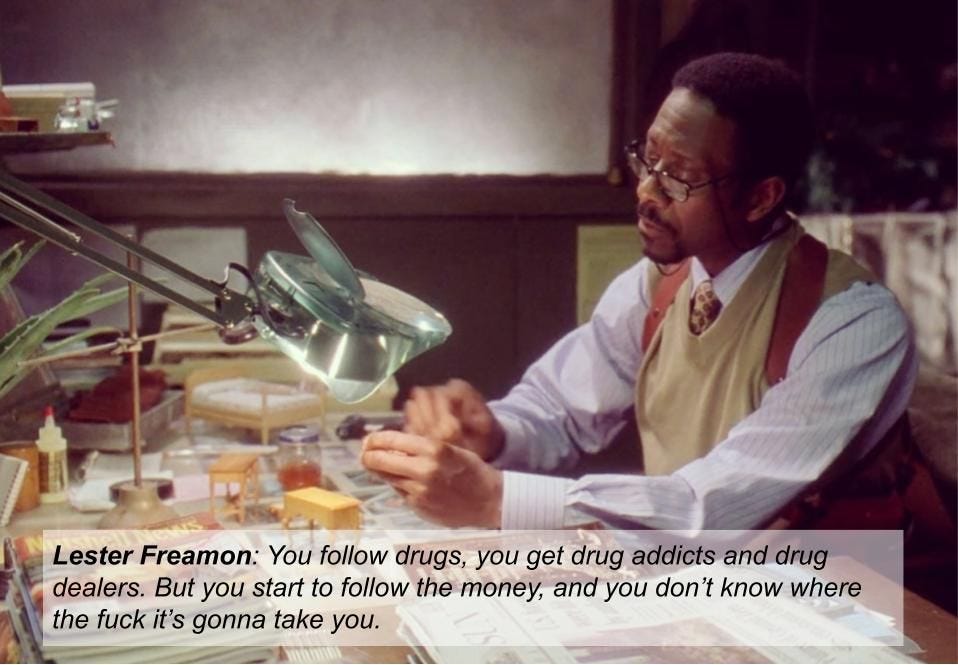
This will be the first in a series of videos that I’ll do from time to time called “follow the money,” where I present an issue, and I explain what the monetary incentives are and who benefits. Since this is Jail Psychologist, I will also explain how each issue impacts or interfaces with the criminal justice and mental health systems.
For our first issue, I wanted to talk about universal school vouchers, sometimes referred to as “school choice,” also known as education savings accounts (or ESAs). I’m gonna say off the bat that if you have not done a deep dive into school vouchers in the past that pretty much everything about these things is confusing. There are lots of types of vouchers and tax credit programs and some of them are for specific purposes like helping students with disabilities, others are universal, some are federal while most are state funded, and every state is a little different. For our purposes, I am going to be looking primarily at state-level universal school vouchers and ESAs, which are basically the “no-strings-attached” version of government funding for private education.
When researching for this essay, I ran across a lot of misinformation. The issue of school vouchers has been highly politicized, with non-partisan monitoring groups, pro-education groups, and political think-tanks all publishing content that not only draws very different conclusions about universal vouchers, but sometimes can’t even agree on how much the programs cost.
Here is how I will approach this, which is the same way I approach every issue on this channel. I am going to evaluate this topic as objectively as I can and ask a simple question: Is this policy likely to improve the lives of ordinary people? Wherever that analysis leads, that’s where I’m gonna go. If the conclusion happens to align with one political party, that’s incidental. If you watched the first five videos in this series then you know that I have problems with both political parties in the US because they’ve both contributed to wealth concentration and the collapse of our living standards.
How Public Schools are Funded
Before we get into vouchers, I need to explain the basics of the public school system and how it’s funded. Public schools in the United States are funded by all three levels of government: federal, state, and local. The exact ratio of funds differs by state and sometimes even by school, but generally speaking, the state government covers about 45% of costs, local governments cover about 45% of costs, and the federal government covers the rest.
It’s worth noting that most states collect taxes in the form of income and/or sales taxes, while most local governments collect taxes via property taxes. This is relevant for us because it means that if property values in an area are low, then they don’t have much money for their local schools, while areas with high property values will have more money to fund their public schools. This creates an incentive for parents who want to send their kids to a good public school. If they buy or rent a home in a wealthy area, their kids will usually end up at better schools. In fact, this phenomenon of public school funding being tied to local property values means that in some extremely wealthy areas, public schools themselves are funded better than the vast majority of private schools.
The funding afforded to public schools is determined partially by how many students the schools have. The more students in the school, the more funding the school receives. For the purpose of today’s discussion, let’s say we have a public school with 500 students, and the school receives $5,000 annually for every student they have enrolled. This hypothetical school therefore has a budget of $2.5 million annually.
Now, it’s important to understand that since this school is funded by tax dollars, everyone in the community is paying for it, regardless of how many kids they have or don’t have in the school. You’re allowed to send one kid, 3 kids, or however many you have to the public school, and there is no direct charge to you as a parent for doing this. The taxes you pay are the same, even if you don’t have any children in the school. You don’t get to say, I want my tax money back because I don’t have any children and therefore am not using the school.
This would be a nonsensical thing to ask for anyway. Public schools are a public good that provides a public service. It’s not like you would call the city and ask for a tax refund from the fire department because you didn’t use the fire department this year.
We need these public services because not having them is potentially catastrophic. Think of what would happen if you had no public schools at all. No public schools means that poor families couldn’t afford to educate their children. Given that about half of US families are so financially stretched that they couldn’t cover a $1,000 emergency, this suggests that about half of the country’s school-age children would suddenly be without an education, and their parents would have to find someone to watch them during the day.
Even if you’re fine with that, remember that if the young people in your community are growing up without an education, that businesses are not going to want to move to your community because your workforce is uneducated. If these young people can’t find work, or can’t find work that pays a living wage, then they’re going to turn to crime and/or drugs to meet their needs. Once you consider all the costs from additional policing, incarceration, and lost productivity, I think you’ll find that skipping the investment in public education ends up costing taxpayers more than if they had just funded public schools from the beginning.
What are School Vouchers?
Let’s say you’re a parent. Your kid just turned 5-years-old, and will be eligible to start kindergarten at the local elementary school in the Fall. What if you don’t want your child to attend the local elementary school? The most common reasons for this would be if you either thought the public school was under-performing relative to other schools, or because you wanted your child to attend a religious school.
Let’s say you would rather send you child to a private school. Well, you’re actually welcome to do that. The US has no law banning the education of children in private schools. Note - I’m going to set aside homeschooling for the rest of this article because it’s kind of niche and interacts with universal vouchers in inconsistent ways depending on what state you’re talking about.
If you want to send you child to private school, you can. The cost of private schools for K-12 varies wildly depending on the grade and the school, but the cheapest private schools cost between $5,000-$8,000/year in tuition (depending on grade level), while the more “prestigious” schools cost as much as $30,000 or more annually. So, if you were to put your children in private school for the entirety of their K-12 education, your out-of-pocket costs would be between $65,000 and $390,000 per child. For reference, about 10% of all children in the US attend private school.
How do school vouchers play into this? School voucher programs basically say, “if you choose to send your child somewhere other than their assigned public school, then you will receive a voucher or coupon for roughly the amount of money that your assigned public school would have received to educate that child, which you may then spend on whatever private school you wish.”
How Vouchers Harm Public Schools
In our hypothetical school example where the school has 500 kids and receives $5,000 per student – imagine that 50 of these students decide to leave the public school in order to take a voucher and go to private school. The school’s budget will be reduced by 10%, from $2.5 million annually to $2.25 million. On this surface, this seems fine, because the school is still getting the same amount of money per student, so the cost to educate them should be the same. However, this reduction in students, and associated funding, does create a significant fiscal problem. That is, a lot of the costs of running a school are what we call “fixed costs.” That is, they just cost what they cost no matter how much you use them.
For instance, let’s say the school has a bus that takes some of the kids back and forth from home to school. You have to pay for the bus, and you have to pay for a driver. That cost is the same regardless of whether the driver picks up 5 kids or 20 kids. The same is true of things like maintenance on the school roof or the use of air conditioning. These things don’t cost less money because you have fewer kids in the school. What happens when public schools lose money because kids are taking vouchers to go to private school, is that the school is forced to reduce costs, but can’t reduce fixed costs. This means that they have to cut things like teacher positions, school counselors, or extra-curricular activities.
My point here is that the cost of running the public school, on a per student basis, is going to go up if a bunch of the students leave the school. So don’t be surprised if a school voucher program starts and the costs of public schools on a per-student basis go up, this is exactly what you should expect to happen.
Why Vouchers are so Expensive
Now, let’s talk about what I would consider the most fiscally problematic aspect of introducing a universal school voucher program. Remember our school with 500 kids in it? It turns out that about 50 additional kids lived in this school zone, but were already going to private schools before the school voucher program was introduced. When the state said that anyone can get $5,000 in school vouchers if they don’t go to public school, all 50 of these kids now get a school voucher, which increases the total cost of education for the government by $250,000, or 10% of their total spending, annually. Note that the anticipated return on this investment, from a taxpayer perspective, is essentially $0, because you’re not educating any more kids, or providing a higher quality education, than you were prior to the voucher program. The taxpayer is simply subsidizing a private choice that some citizens were already making prior to the introduction of the voucher program.
Following the Money in Arizona and Iowa
What we’re doing in this episode is following the money, right? Let’s look at who school voucher programs have benefited the most. I want to take Arizona as our example state, because they were the first state to adopt universal school vouchers.
A study by the non-partisan Grand Canyon Institute released in February of this year looked at the students who were receiving vouchers in Arizona once the program had been implemented. What they discovered was that about 75% of the students who received voucher money (to the tune of about $872 million) were students who were already being educated in private schools. In other words, the vast majority of the money that the government spent on vouchers went to wealthy families who didn’t really need it.
You could argue that this was unintentional. Like, “oh no we didn’t realize that this was a big taxpayer subsidy of wealthy families!” But this program has been in place for more than 3 years now. The Arizona legislature knows how this is working. The redistribution of public money to wealthy families is a feature of school voucher programs, not a bug.
Arizona is just one example of this. If you look into the universal voucher programs in Iowa, Florida, Arkansas, or Ohio, you find a similar pattern.
To make my next point, I want to move to Iowa, which implemented their universal school voucher program the year after Arizona. The average voucher in Iowa pays about $8,100 per student.
Imagine for a moment that you are in charge of a private school in Iowa. Let’s say that your annual tuition prior to the universal voucher program was $9,000, which is fairly typical for private high school tuition. What would you do if you learned that your state was going to cover the cost of the first $8,100 of tuition for every student, regardless of their family income?
Let’s consider your options and incentives:
· Your first option is to do nothing. You keep your tuition and services the same, and your students and their families get some financial relief.
· Your second option is to raise tuition, because you already know that the families of the children at your school could afford to pay the full tuition before the vouchers, so they can definitely afford to pay it with an extra $8,100 annually.
If you do raise tuition, you want to keep it modest. If you were to raise tuition by $8,100 then the families at your school would be furious because their school vouchers would be entirely eaten by this price hike. What you would want to do is increase tuition moderately so that at the end of the day the families attending your school still get a financial break, and your school can pocket some of that free government money.
How do you think Iowa private schools responded to these incentives? It turns out we don’t have to guess, because there’s a research paper which tracked changes in private school tuition after Iowa implemented their voucher program. It turns out that after the state’s voucher program went live, the average private school in the state increased their tuition by about 23%.
So before school vouchers, if the average school tuition was $9,000 annually, then families paid $9,000 annually. After school vouchers, the average school increased tuition by 23%, so for the sake of our example, to $11,070, and families paid $2,970. So, the family saved about $6,000 annually on tuition, and the school’s profits rose by 23%. I can’t tell you what the school did with that extra 23% in revenue. Maybe they increased teacher salaries, upgraded their facilities, or simply paid it out as bonuses to administrators. The thing about private schools is…they’re private.
To summarize what we’ve discussed so far, universal school vouchers significantly increase the cost of educating children, drain resources from public schools, subsidize wealthy families, and enrich private institutions. None of these things seem like desirable outcomes for a government program, especially in states where a lot of elected officials claim to be fiscal hawks. On top of this, since these programs effectively make the rich richer and the poor poorer, these universal vouchers contribute to the big problem that we’re always talking about on this channel, which is wealth inequality, otherwise known as asset concentration.
A quick refresher on how this works: If you give a starving family $8,100, they’ll buy food with it. If you give a working family $8,100, they might fix their fence, upgrade their appliances, or pay down their mortgage. If you give a wealthy family $8,100, they don’t really need it, so they’re just going to use it to buy assets. Go back to episodes 1-5 if you need a refresher on how this behavior causes wealth concentration and how wealth concentration causes population-wide mental health problems.
School Vouchers in the Context of the Criminal Justice and Mental Health Systems
How would we expect the criminal justice system to be impacted by school voucher programs which expend public resources while reducing the quality of public education?
We know that several variables are associated with increased academic achievement and increased graduation rates for students. These include: smaller class sizes, more experienced teachers, more access to mental health resources like social workers and psychologists, more extra-curricular activities, more school support staff, and better facilities. If increases in these variables means increases in graduation rates, then it stands to reason that decreases in these variables would be associated with decreased graduation rates. The introduction of universal vouchers tends to decrease all of these variables for public schools, reducing the chances that public school kids will graduate from high school.
What do you suppose happens to students with low academic achievement who fail to graduate from high school? They have reduced lifetime earnings, are significantly more likely to live in poverty as an adult, are significantly more likely to be incarcerated, are more likely to develop a substance use disorder, and have significantly higher rates of all-cause mortality. On top of all of this, data from the CDC indicates that failing to graduate from high school increases the risk of suicide by 30%.7
In other words, a kid not graduating from high school is basically a disaster, and the number of times this happens is undoubtedly going to increase because of school vouchers, which are simultaneously spending taxpayer funds to subsidize the education of wealthy families, and contributing to a mental health epidemic.
Summary and Conclusions
So…universal school vouchers are ultimately…bad. I mean, I’ll explain this one more time. 75% of the money from these very expensive, taxpayer funded school vouchers, is going to families who are already doing well enough financially to be able to spend thousands of extra dollars per year to send their children to private school.
The government is funded by taxpayer dollars, with a mandate to serve everyone. When it does this kind of thing, and spends public money to give gifts to wealthy citizens, the richest of whom don’t even pay income taxes anyway because of the buy-borrow-die loophole we discussed in episode 5, it makes it obvious to anyone paying attention, that rather than serving everyone, the government is primarily serving wealthy interest groups. This kind of government capture, by the way, is both a cause of, and a product of, extreme wealth concentration.
I make videos about how economic policies impact mental health. What do you think it does to the mental health of ordinary citizens, many of whom are struggling to feed their kids and pay their rent, to learn that their government is effectively stealing money from them and giving it to wealthy people? You don’t have to be a psychologist to answer that.
The solution to this problem is basically just to repeal all of the universal voucher laws. Vouchers themselves arguably have a place. I’m not actually against targeted school vouchers as a concept. I think they can be useful when they are made available to financially needy families who have children with special needs.
Let’s say you had a poor family who had a child who was deaf. Even the best-resourced public schools don’t have a lot of teachers who know sign language. In niche cases like this, I think it’s perfectly fine for the state to provide voucher support so that this child can go to a special school for deaf children where the entire academic environment is shaped to support their needs. I’ve been to some schools for deaf students, and if I were deaf, I would definitely prefer these schools over a public school.
That’s school vouchers and how they contribute to our collective economic and mental health problems. I think what you’ll see as we do more of these episodes in the future, is that a lot of the policies we’ll look at that have these very-well paid PR campaigns designed to make them look good, are, when you actually look at where the money is going, programs designed to redistribute wealth from ordinary people to the very rich. School vouchers happen to have the knock-on effect of de-funding the education of ordinary children, which is a nice bonus if you’re a rich person because these ordinary kids will grow up not knowing enough about what you’re doing to them to be able to fight back.
Fortunately, some of us, which now includes you dear reader, have enough education to see through this propaganda. The way we fix it is to vote better people into office. So…tell your friends, tell your family, tell your neighbors, tell your elected officials, not to support universal school vouchers.
This article (https://www.propublica.org/article/private-schools-vouchers-growth-florida-arizona-west-virginia) from ProPublica just released today. It's a good read that compliments my position on this issue.